The Geomancer

8/29/08

THE FORCE UNLEASHED unleashed at last

When I was offered The Force Unleashed at the end of 2006, the decision to take it on or not was a no-brainer. Who wouldn't grab with both hands at the chance to novelise the latest LucasArts computer game? Occasionally billed as Star Wars: Episode 3.5, in which Darth Vader's secret apprentice wreaks havoc on the GFFA and the rebellion is born, it offers a glimpse into the Dark Times--a period of fictional history I'd been wondering about ever since seeing "A New Hope" as a wide-eyed 10-year old in 1977. No schedule is too tight for something like this.

The only downside has been the cone of silence surrounding the story--but now it's out and people are reading it, the embargo has finally been lifted. I'm thinking of that wonderful Simpsons episode with the musical version of "Planet of the Apes."
"He can talk. He can talk. He can talk. He can talk."
"I can SING!"
Anyway, the fans seem to be excited too. The Force Unleashed will debut at #1 on the New York Times hardcover bestseller list next week. That's just icing on the cake, folks. Thanks to everyone who's bought a copy. I hope you enjoyed it. (Don't forget to buy the game. It kicks ASS.)

Podcast: Yours Truly in Agony (Again)

The incredibly-well read and well-spoken Rick Kleffel and I discuss space opera today on the Agony Column podcast. Rick was enthused by reading Brian Greene's Icarus at the Edge of Timeand Peter F. Hamilton's Pandora's Star,neither of which I've read, but both of which sound right up my alley. So we talked about these works, about John Meaney's Nulapeiron Sequence, about Kay Kenyon's The Entire and the Rose series, about the general qualities of space opera, and about the differences between Star Wars and Star Trek, and whether Trek is space opera or military SF. Here's the direct link to the mp3, and you can also subscribe via iTunes.

Which you should. Rick is an amazing interviewer, asking really insightful questions, and his podcast covers a wide range of book-related topics. He covers enough works of a science fiction nature that I can justify my time as keeping me informed about the rest of the field, and enough works outside it that I don't get myopic. For example: My favorite in recent weeks, his interview with Charles Bamforth, 30 year head of research for Bass and the author of Grape vs. Grain: A Historical, Technological, and Social Comparison of Wine and Beer.And here's the direct link for that.

8/28/08

Pat's Fantasy Hotlist Interviews David Louis Edelman

Patrick St-Denis has just posted an interview with me on his popular Pat’s Fantasy Hotlist blog. Subjects covered include Infoquake, MultiReal, Lou Anders and Pyr, my strengths as a storyteller, the John W. Campbell Award, cover art, websites and interactivity with readers, the trend of high-quality British SF, and whether SF will ever get proper literary recognition by snooty academics cowering up in their white towers.

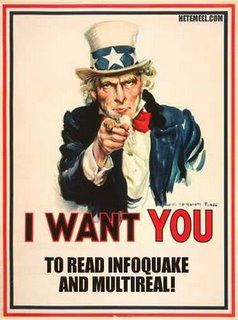
I Want You to Read 'Infoquake' and 'MultiReal'But the best part of the whole thing is that Pat has seen fit, unprompted, to post this neat little Photoshopped poster that puts the full force and weight of Uncle Sam behind getting you to read Infoquake and MultiReal. And really, ain’t that how it should be?

Brief excerpt from the interview:

What do you feel is your strength as a writer/storyteller?
I feel like I’m very good at the worldbuilding aspect of things. Really, structure in general. The trilogy has layers and layers of metaphor in it, and I’m really quite proud of the way it all works together as an organic whole. My tendency is to wander off into history and background and structure, and sometimes I have to curb that impulse. If I had written The Lord of the Rings, it would have been three whole books of the Council of Elrond, and nobody would have read it.

Were there any perceived conventions of the science fiction genre which you wanted to twist or break when you set out to write Infoquake and its sequel?
Yes, I wanted to avoid the typical mindless action set-pieces that you find in a lot of bad SF, and bad novels in general. I really wanted to write an exciting novel about business. A lot of authors just use the business aspect as window dressing, and then quickly throw their characters into the same car chases and murder mysteries and gunfights. I wanted to write books that really are about the workplace, where the excitement revolves around product demos and marketing meetings and government hearings and that kind of thing. So that’s what I’ve tried to do.

Mind Meld: Is it Time for Star Wars to Go?

SF Signal is back with another Mind Meld, this one asking, "Is it time for Star Wars to go on hiatus for a long while, or is there hope the new, live-action TV series will breathe new life into the series?"

Answers are from such notables as Keith R.A. DeCandido, John C. Wright, Pete Tzinsky, John Hemry, Bruce Bethke, Jeff Patterson, Jeanne Cavalos, Andrew Wheeler, and Yours Truly. My favorite response comes from Andrew Wheeler, who says, "Actually, 'The Star Wars Franchise' is one of those wonderful fannish constructions, which has always existed more fully in the collective consciousness than in reality (and even more so in the rationalizations of a million fans talking at once). Consider Boba Fett -- the biggest badass in the galaxy, on the basis of about five lines of dialogue and some battered old armor. Fett's image was almost entirely constructed by the fans' desires and dreams, goaded on by the fact that his action figure was a rare giveaway when they were mostly young and impressionable."

8/25/08

WorldCon 2008 / Paul Cornell's Denvention3 Report

Paul Cornell's belated WorldCon Report is probably my favorite convention report ever and well worth reading. He begins, "Worldcon is always too big to blog about. It’s a culture, a civilisation. It lasts just long enough that you start to think of it as a career, and then it goes away. It always leaves me inspired, wanting to write, wanting to be one of these people always."

And look, right in the middle, this incredible review of David Louis Edelman's MultiReal:

"I was reading David’s sequel to Infoquake, that is Multireal, during the convention, and as always it spoke to me about my life like no other author does. As much as I loved Infoquake, Multireal is better. It’s The West Wing, in the world of big business, in the future, all last second deals and human emotion finding desperate chances and tense negotiations, but this time with added sex and violence. I was almost disappointed to find some, in that last time David had me on the edge of my seat with only one burst of gunfire and the glimpse of an ankle, and I was hoping to see that feat again, but this book soars mightily, and presents me with terms I find myself mentally using in everyday life (the fiefcorp of Pyr Books, the memecorp of the BBC), and situations redolent of it. The bar and the panels and the awards map onto the fingernail biting world of freelancing in the future. It’s not, as I thought after the first book, a work of Mundane SF, because the (albeit unreliable and hardly magic) teleportation just about rules it out. But I still believe that this world, almost uniquely in modern SF, isn’t just a commentary on the modern scene, but might also come to pass. David has thought about who empties the bins. And his singularity came and went and those bins still needed to be emptied. Most wonderfully, two big set piece speeches in the middle of the book, which sum up its themes of governmentalism vs. libertarian capital, dissolve into the most brilliant shit-flinging gunfight and escape, and one can hear David laughing, shouting ‘yeah, you can have both!’ The mass market paperback of Infoquake was in the bloody airport bookstore on the way out. I’m saying not just Campbell next year but come on, let’s say it out loud, Best Novel."

Podcast: Lou on Writing Excuses

At the recent World Science Fiction Convention, I was honored to be a guest on Writing Excuses, the podcast of writing advice hosted by Brandon Sanderson, Howard Taylor, and Dan Wells. The episode is available on iTunes and elsewhere, and here is the direct link. Their description:

So what exactly does an editor, do, anyway? We’ve already talked about the process of submitting to an editor; today we talk about the millions of vital things that happen after an editor says “I want to buy your book.” Not only that, but we get to hear it all straight from the mouth of Lou Anders, the Hugo-nominated editor from Pyr Books, who this year alone helped create a Hugo-nominated book and two Campbell-nominated authors. In other words: when this man talks about editing, you listen.

8/23/08

Does Nostalgia Do SF a Disservice?

Over on Futurismic, Paul Raven points to a post by Ian Sales saying, "Readers new to the genre are not served well by recommendations to read Isaac Asimov, EE ‘Doc’ Smith, Robert Heinlein, or the like. Such fiction is no longer relevant, is often written with sensibilities offensive to modern readers, usually has painfully bad prose, and is mostly hard to find because it’s out of print. A better recommendation would be a current author - such as Richard Morgan, Alastair Reynolds, Iain M Banks, Ken MacLeod, Stephen Baxter, and so on."

To which I say, "Amen."

I was in Barnes & Noble some months back and bumped into a friend of mine with his daughter. He told me she had been assigned Fahrenheit 451 at school, to which I replied, "You poor girl. You are going to hate it. It's about an old man whining that his wife watches too many soap operas, and nothing happens it it until the cities arbitrarily blow up at the end on cue. Please don't think that's the sort of thing I do for a living. Come with me." Then I walked her over to a display of Scott Westerfeld's Uglies books and said, "Here, this is much more representative of contemporary SF. Try this."

I bumped into them a month later and asked how it went. I found out that, as predicted, she hated the Bradbury, but they were there so she could pick up the third book in the Uglies series. She is now an avid Westerfeld fan.

This isn't to say that I didn't enjoy Bradbury, or that it is not of historical importance, or that *working professionals* in the SF field and wanna-be-writers don't have a responsibility to know their history so they don't struggle to reinvent the wheel, but half-a-century old fiction is NOT the starting point for newbies who have never encountered the genre before. People coming in cold, particularly people coming in from positive encounters with media SF&F, ought to start with contemporary writers. When I set about to recommend books to new SF&F readers, I typically ask them what kind of films they like and then pair them on that basis. The Matrix? Try Charles Stross, Karl Schroeder, Ian McDonald, Cory Doctorow, etc... Buffy the Vampire Slayer? How about Jim Butcher, Patricia Briggs, Justina Robson. Star Wars? How about Gardner Dozois and Jonathan Strahan's The New Space Opera, or the works of Karen Traviss? Firefly/Serenity? - Mike Resnick's Santiago books, and his current Starship series. Eternal Sunshine of the Spotless Mind/Being John Malkovich? Something by Jonathan Lethem, maybe As She Crawled Across the Table.

I have met so many people, who when they learn what I do, tell me "Oh, I tried science fiction once. I didn't like it." When I asked them what they read, they invariably say they went into the SF&F section, started at the A's, and grabbed the first thing they recognized - Isaac Asimov. Tried it, and found it cold and dated.

Again, this is NOT to say that the enthusiast, the purest, the aficionado, the die-hard, the wanna be, the professional, the completist shouldn't read the A,B,C's of the Golden Age, or that those texts no longer have anything to say to us, only that if someone came to me having just seen The Bourne Ultimatum and wanted to know what contemporary spy novels he or she should read for more of the same, I wouldn't start him or her off with Joseph Conrad's The Secret Agent. (If they *end* up there, fine, but I wouldn't *start* them there).

I think matching them with the analogous movie works best (produces better results than asking people what sort of "mainstream" they read), though 9 times out of 10, you'd do just as well to just hand them John Scalzi's Old Man's War.

8/22/08

Matthew Sturges on Major Spoilers

In early 2009, we'll be bringing out Matthew Sturges' Midwinter, about which much more when we get closer. But the Eisner-award nominated Sturges is already well-known to comic book fans, as he's the author of such DC/Vertigo titles as Blue Beetle, Jack of Fables (with Bill Willingham), House of Mystery, and others. Today, the podcast Major Spoilers conducts and interview with him. Here's the direct link.

8/21/08

World War: A Short Animated Film

Via SF Signal, a short CGI film of two robots fighting in Hiroshima, Japan, 100 years after the end of World War II. More evidence that the future of SF film isn't limited to Hollywood, California:


World War - 3D Animation @ University Of Hertfordshire 2008 from Digital Animation Herts Uni UK on Vimeo.

8/20/08

Writers' League of Texas panel on comics, manga and graphic novels

If you're in Austin, and things like comics, manga and graphic novels interest you, drop by Spider House this Thursday, August 21 for a panel devoted to just those topics. I'm one of the panelists; by day I am a novelist, but by night I don my nerd costume and write comic books.

Here's the blurb:

One of the hottest areas in publishing is comics, graphic novels, and manga. Paul Benjamin heads up a panel of writers in the field to offer an insider's look at the popular art form and the creative process. Panelists include Scott Kolins, Alan Porter, Tony Salvaggio, and Matt Sturges.


Link.