The Geomancer

Showing posts with label Pyr and Dragons Adventure 5th Anniversary Contest. Show all posts

9/8/10

DragonCon 2010: The Mardi Gras of Middle Earth

This past weekend was Dragon*Con, that annual event where tens of thousands of attendees, many of them in costume, descend on downtown Atlanta for four days of genre mania each Labor Day weekend. Last year, I attended Dragon*Con as a guest and was blown away by what a book-friendly, age-diverse audience it was, as well as by the staggering number of authors, editors, and publishers also in attendance. Based on that impression, I returned to Dragon*Con this year as an Exhibitor and roped in my Director of Publicity, Jill Maxick, my slush reader Rene Sears, and NINE of our authors.

Sans Instructions!
I arrived late Wednesday night, in order to be on sight to set up our booth bright and early Thursday morning. We had a corner table in room 1601 of the Marriott Marquis' Imperial Ballroom, which was a tremendous location (and put us across the aisle from the very cool guys working the Utilikilt booth. I admit I was tempted, but didn't succumb. Maybe next year).  The Pyr booth itself hasn't been used since the 2005 San Diego Comic Con. It's a very cool design, a wireframe scaffolding that accordians up from a tightly packed container-friendly size, held in place by segmented bars which are themselves lined with magnetic strips to hold the velcro-friendly walls of the booth. The whole thing fits in an oval shaped black box that doubles as a display stand. Of course, the packaging comes without any instructions of any kind, so assembling it on my lonesome Thursday morning, with only vague memories of having done this with help in 2005, had a fair share of "what the hell am I supposed to do with this?" moments. I admit, though, that it was sort of a fun puzzle-challenge, and the whole set up (including book display) only took from about 10am to 4:20 pm. (Only!)

The Pyr booth, before opening.
Thursday night itself was a rewarding meal (serving as both my lunch and dinner) at Max Lager's with Sam Sykes, Clay and Susan Griffith, John Picacio, and Jill Maxick. This was my first time meeting Sam, Clay and Susan, and I was delighted to discover they are all wonderful people (I already knew this about John and Jill). Then Friday morning, Jill and I returned to the Exhibitor Hall where she proceeded to build the artfully arranged stack of Pyr Sampler Books (we had 1046 in all) and we made final preparations for the imminent crowd.

The Electric Boogaloo.
Straight up: It was a grueling con, from running a booth for four days (1pm to 7pm on Friday, 10am to 7pm on Sat and Sunday, 10am to 5pm on Monday) while also participating in programming, and still trying to get face time in with my people (six of whom I was meeting for the first time in the flesh). It was a slog to drive down late Wednesday night and then work the show until Monday night. Probably one of the hardest shows I've worked, and I did it with just three hours sleep most nights. And it was hard on my long-suffering family to be without me for so long. So, was it worth it?

Middle Earth Mardi Gras
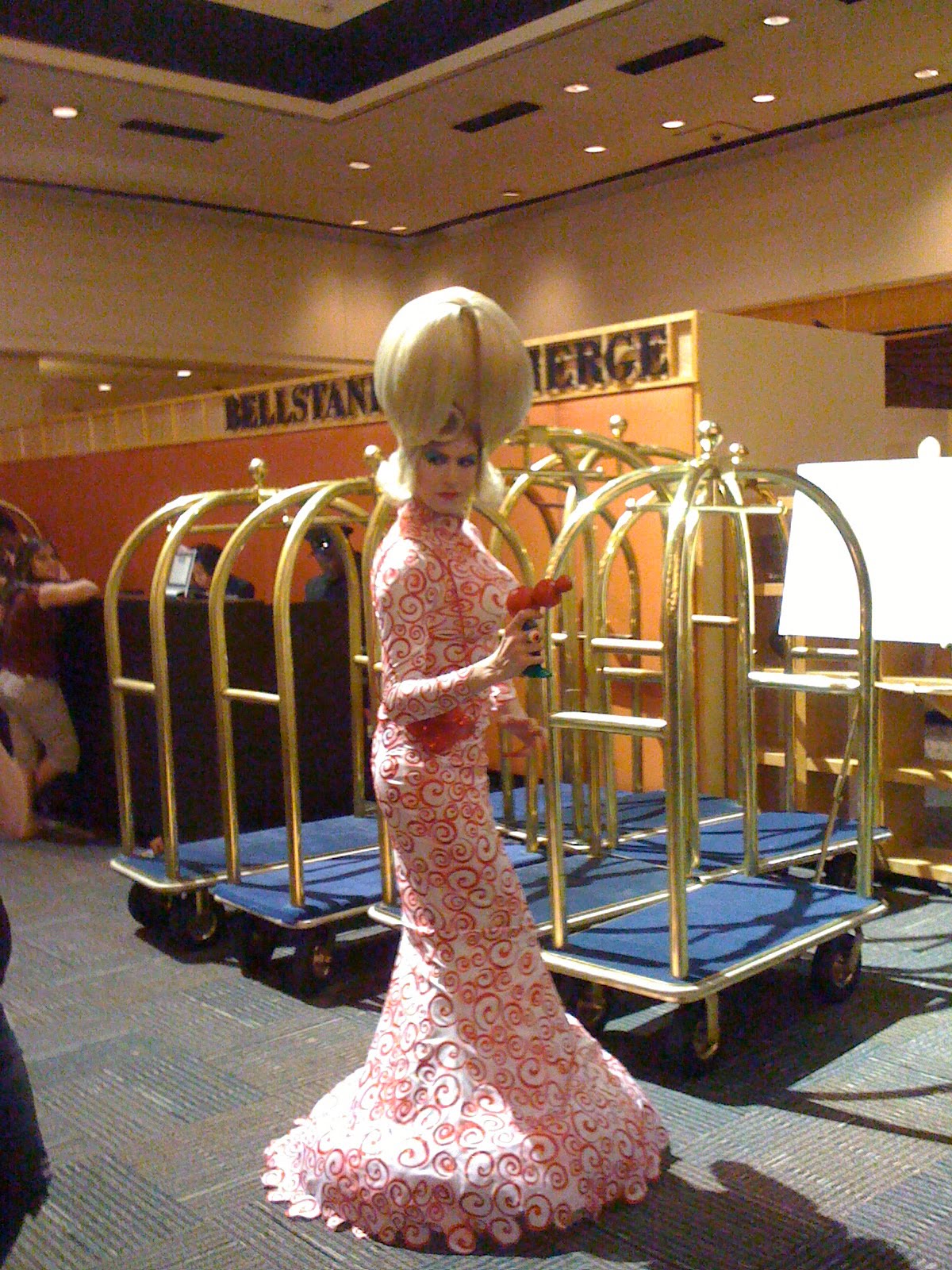
The convention was incredible!!! It has to be seen to be believed. The number of attendees I heard floating around was 65,000 and I could believe that or more. It comprises five hotels, with attendees staying in another five or so official overflow hotels, and quite a few other hotels in the neighborhood or thereabouts. I know they had 32,000 preregistered attendees as of last year's con, and that the registration lines for on-site registration were over THREE HOURS LONG. The only real way to describe Dragon*Con is like Spring Break in a Fantasy World or some sort of Middle Earth Mardi Gras. The hotels are jammed packed, particularly in the evening, where the lobbies of all the hotels are just unnavigable seas of bodies, many of them wearing little more than furs and duct tape.

Yep yep yep...uh huh uh huh!
But unlike the San Diego Comic Con, which is much more of an Expo for Big Media Movies and Games, and whose value (at least for me) lies in the business meetings you can take with your opposite numbers in sister industries in the bars and restaurants across the street, Dragon*Con has much more of the feel of a fan-run convention that has simply grown to ginormous proportions, which it is. What I discovered last year and had confirmed this year is that there is a HUGE & RECEPTIVE BOOK AUDIENCE at this convention, and one that spans a broad age spectrum. (I shared an elevator with a young girl dressed as Alice who was panicking that she was late, late - for a very important date? irony lost on her - for the fantasy LITERATURE panel. Not the manga panel or the Warcraft panel but the literature panel! She was not atypical in this interest for her age range at the show.)

You will buy my book
As aforementioned, we had made special for the con a Pyr Sampler Book, as well as a limited edition lapel pin celebrating our 5th anniversary. We gave out all 1046 of the Pyr Sampler Books. In fact, they had disappeared by Saturday morning, in no small part due to the efforts of Sam Sykes, who fostered them on people in a manner which was described by James Enge as Sykes "free from any sense of mercy, compelled people to take the free stuff. In compensation, he let them buy a book every once in a while." We have also gone through all but about 250 of our 2000 Pyr 5th Anniversary Lapel Pins by Monday afternoon. We introduced the Pyr brand to thousands of people. And we sold a hell of a lot of books.
Monday Morning - not even over!

One of the most amazing things to me personally was how effective the Pyr Sampler Book was. Most of them disappeared on Friday, and Saturday morning, literally scores of people came up to us (that day and all the other days too actually) saying they'd read the Sampler Book and they wanted to pick up this book or that book. I was astounded. We assumed people would take these things home to peruse them at their leisure. But they read them Friday night? "Weren't you out there drinking with the 65,000 other people?" I asked one young guy, who didn't seem like the type to pass on this Toklienesque Fort Lauderdale. "Yeah, man," he replied. "I drank till 3:30am, then came back drunk and read your book until 5am. Can I get Tome of the Undergates?

Mars Attacks!
Friday night at 7pm we had a Pyr Books Presents panel, complete with all nine attending authors: Mike Resnick, Jon Sprunk, Sam Sykes, Clay and Susan Griffith, James Enge, Erin Hoffman, Andrew Mayer, and Ari Marmell. Given how many there were of us, they each got 4 minutes thirty seconds to talk about their books while I flashed the cover image on a screen. Even this rigid time constraint took most of the hour, but left about 10 minutes for audience questions. We heard all weekend how great the panel was, and lots of people who came to the booth on Saturday, Sunday and Monday said they came because of this (and the two art panels I did, both of which also featured Dragon*Con special guest John Picacio).

Dinner with the Winner!
In celebration of our fifth birthday (March of this year), we had previously held a "Pyr and Dragons Adventure Contest," for which fans were invited to submit a short essay on the theme Five Reasons Why Science Fiction And Fantasy Is Important To You." First prize was a trip for two to Dragon*Con and dinner with a group of Pyr authors (as well as myself and Jill). Lisa Iriarte won the contest - you can read her essay here. Lisa teaches seventh-grade language arts and has recently written what she hopes will become her first published novel, Assassin's Nightmare. She and her husband Joe joined myself, Jill Maxick, Mike Resnick, his wife Carol, James Enge (and daughter), Jon Sprunk, and Sam Sykes for dinner at Sear in the Marriott. Lisa and Joe were both very nice. Really sweet people, both with aspirations of writing, and Mike Resnick's unending font of amusing anecdotes about the business was spot on for the makings of a special evening.

The Amazing Clay and Susan Griffith.
We sold out of limited number of copies of Mark Hodders' The Strange Affair of Spring Heeled Jack we had with us very early on, as well as all the copies of Jasper Kent's Twelve, and the 100 Free ARCs of The Greyfriar (Vampire Empire Book One) were a hot ticket item on Saturday. I don't think we could have had too many copies of these book on hand for this show, where steampunk and vampires are so very king. And The Society of Steam stickers that Andrew Mayer himself made in promotion of his May 2011 title also proved to be EXTREMELY popular.

"I know this music."
Saturday night, a group of us, which included Tor art director Irene Gallo, stayed up entirely entirely too late. Too late is defined as 2:15am when one has to get up three hours later at 5:15am for the Live Hugo Awards Breakfast. Organized by Stu Segal, the breakfast featured "LOU ANDERS (4 time Hugo Nominated editor), KATE BAKER (podcast director for the twice nominated Clarkesworld), EUGIE FOSTER (Nebula Award Winner), MARY ROBINETTE KOWAL (Campbell Award winner), FARAH MENDLESOHN (Hugo winner, and current nominee), JOHN PICACIO (Winner of the World Fantasy, Chesley and Int'l Horror Guild Awards and 6-time Hugo nominee) and STEPHEN H. SEGAL (Hugo winner, and current nominee)." I'm enormously touched by those few fans who braved the early morning hours to watch all but Kate Baker lose in real time! (Also touched by Robert J Sawyer, who came by later to bring me the Hugo Voting Report, so I could see that I was first in nominations, and second place in the final round!) This was followed by Stu's Stroll with the Stars, a leisurely one hour walk around the neighborhood. Sunday morning's stroll was "Pyr themed", though at least two of our authors overslept, including one who had buggered off from the bar before the rest of us despite not having to get up at 5am. At any rate, Sam, you know who the real man is.

Sprunk, Anders, Sykes.
Having authors in the booth made a huge difference. Sam Sykes had sold out all copies of Tome of the Undergates by Sunday morning. (I say "Sam had sold" not "we had sold" because Sam has a very healthy sense of competition and was determined to insure by any means necessary that he sold out first. See James Enge's aforementioned comment about Sykes and mercy.) Jon Sprunk was right behind him though, despite a much more understated presence. In fact, I sold a lot of Shadow's Son on Monday, after Sprunk had left, to people who told me they were buying the book because they'd talked to Jon over the weekend and "he was just such a nice guy" that they wanted to. James Enge was also a tremendously nice guy. So nice that he spent more time recommending other authors' Pyr books in favor of his own, but we still managed to sell out of his WFC award nominated Blood of Ambrose by end of day Monday.

James Enge wants you.
Clay and Susan Griffith were invaluable. They are former booksellers who volunteered their time and expertise. They brought us food, they worked the booth, they hand sold, and they helped with take down in the evenings. They were incredible. I'd also asked my slush reader/editorial assistant Rene Sears to help out "just for a few hours when I'm on panels." Instead, when we got there and saw what a madhouse it was, we ended up leaning on her heavily. She worked the booth for most of the con, right up until Midday Monday. I cannot stress how amazing she was. Nor how impossible the weekend would have been without her.

Sunday night was another dinner at Max Lager's, where I got to sit down and spend real time with James Enge, and then it was off to the Marriott first and then the Hyatt for more beer. I ended the evening sitting between Mike Resnick on my right and Todd Lockwood on my left. Mike was giving agent advice to my friend David Alastair Hayden and Todd was giving artistic advice to Randall Ian Mackey,  my friend and cousin's husband, who is looking to launch a career in concept illustration. It was really gratifying to just sit there and watch my friends help my friends.

Cooper, a trooper.
I was amazed to see that the crowd, although a little thinner than on the weekend, hadn't thinned out appreciably on Monday, which proved to be a really strong sales day. Jill had flown back the previous evening, so it was myself, Rene Sears, and Clay and Susan Griffith working the booth. And my good friends, the aforementioned David Alastair Hayden and his wife Cooper Chun were there as well. Cooper took our bowl of 5th Anniversary Lapel Pins and stood in the aisle a little ways away from the booth, offering people the pins, explaining to them what the pins were for, and directing them our way. She stood there all afternoon, giving a perfect sales pitch. (David calls her his Pepper Potts. And it's no insult. When the rest of us were staring at the scaffolding of the booth, wondering how to disassemble it, she stepped forward, studied it for two minutes with hands on hips, and then said, "you just press here" and then the whole thing accordioned down to the floor. Cooper makes things work.) We had five people in addition to myself helping with take down and reboxing, and what took me six and a half hours plus to do on my own took well under 2 hours with their help.
Bats and Cats

And that really characterized the convention for me. With a "Little Help From My Friends" could have been the theme song. I had never met Sprunk, Sykes, the Griffiths, Marmell, or Enge before and now they are all fast friends. Clay remarked one evening when I thanked him for all the help in the booth "We felt like we were part of the Marvel Bullpen during the high Silver Age!" We learned a lot, and we could run an even better booth next year based on these learnings, but what I really learned was that we have the greatest authors and friends in the whole wide world. And that, as long as they are there with you, the Mardis Gras of Middle Earth is a great place to be.

7/21/10

"Survival of the Fiction" -- the third-place winner from our "Pyr and Dragons Adventure" contest


L. Lambert Lawson of Escondido, California wrote the third-place essay in our "Pyr and Dragons Adventure" fifth anniversary contest. Lawson—the founder and editor-in-chief of Kazka Press, an online magazine devoted to fantasy fiction—will receive five complimentary books of his choice from the Pyr catalog as well as a commemorative Pyr fifth-anniversary keepsake.

We are pleased to post his contribution:

Survival of the Fiction

by

L. Lambert Lawson

From 2005-2007, I, along with 115 other Americans, served as a Peace Corps Volunteer in Ukraine. We fanned out across that former Soviet republic, peopling formerly irradiated villages and sleepy, vodka-distilling and -swilling towns to do a job: teach English. However, we all realized the more important job: survival. On my end, survival hinged, in both profound and peculiar ways, on access to fantasy literature, a truth at the heart of this essay.

Under a cerulean sky, a man with whom I shared a no common language, aside from the ability to waggle limbs to communicate some great need, grasped me by the shoulder and marched me into a copse of birch. He thrust a spade into my hands and motioned to the shaded earth. Dig. A large man, clutching a sharpened trowel of his own, and a colleague of my host mother, he commanded me with his stature. I saw myself drop my knees and commence digging—my perspective omniscient third-person. Was I being hazed? Could a full-grown man dig his own grave, in partial view of loved ones, with a tool meant for divesting a victory garden of its weeds? I thought of Roland Deschain, of Tyrion Lannister and Mike Havel; channeled their courage in the face of fear; and broke apart the loose dirt. Four minutes in, this man waved his hands at me.

Stop.

He then transformed his fists into claws and squirreled at the air as if rescuing a harvest of acorns from an invisible tree. Dig with your hands.

My mind passed from story to story, from Dragonlance to Mid-World to Middle Earth, and remembered the heroes of those landscapes. Life faced none of them as a series of normal events. Life was raw and churning; moving forward did not come cheap: one had to cross the Rubicon into territory heretofore uncharted. The best readers follow no maps; the best writers include them as frontispieces at the insistence of publishers who “know what the market wants.” Thus, I plunged forth, when my unfortified self might have buckled from uncertainty and isolation, and dug my fingers into the dark earth. A few inches down, I found my treasure: a bottle of samahon, Ukraine’s most potent homemade vodka, and a story that would splash from that center and onto all the new shores I encounter. Fantasy literature provided me mettle when I might otherwise have mewed. Thus, it remains core to me.

Rolling across that hallowed Ukrainian ground, from Kyiv to Kharkiv to L’viv, the wandering cultural capital of Carpathians, one’s constant travel companion is a novel. Train cars are crowded, and passengers never tire of ogling the foreigner. A book is defense. The denser, the better. I was never without a sprawling epic or two on any trip I made; I often reread a tattered volume from Martin’s A Song of Ice and Fire juggernaut. Fantasy literature, like no other genre, publishes books like bricks, tomes like tools. In my two years, the volume A Game of Thrones became a truncheon to ward off a drunk, a block to force windows open in sweltering coupe cabins, and a perfect-bound roll of toilet paper. Using the words of Ned Stark to wipe my ass is neither embarrassing nor an affront to Martin and his Westeros, a work like The Bible to me. Instead, I view it as a sacred link in my tale – I who live more for story than for etiquette. Who else would I clutch in my fist, hovering anus down over a Turkish toilet in a bathroom bereft of paper products but Martin? Who else could cleanse me; save me from developing a rash on my impending 17-hour, cross-country train ride; and still provide enough leaves for reading on my journey home? Without fantasy literature, I would’ve been accosted by drunks, boiled alive in coupes, and squirming in shit for ¾ of a day; thus, it remains savior to me.

During Ukrainian winters, evening begins at 3:00 PM. The dark descends, and one has two choices: frolic in the night and become a statistic or become intimate with every livable space in one’s apartment. Of those Peace Corps Volunteers who terminated their services early, the crux of that decision often stemmed from an incident in the nighttime. Muggings. Brawls. A rape. Night, in large doses, was not for survivors. Therefore, Peace Corps had a large, unofficial, and always mobile library of fantasy (and other) fiction. There’s only so much Scrabble to play or tea to host or Lost to watch. Eventually, into everyone’s hands a book must fall.

From October 2005 to November 2007, I read 107 books – not the most in my group but still a veritable survey of modern fantasy fiction. Soaking up as much of the history, environment, and people of L’viv as I could in daylight hours, I slid into Gilead and Chiba City after dusk. The hundreds of thousands of words I read, and the worlds they imagined, kept me safe during nights when neo-Nazis paraded below my balcony and broke windows on my boulevard. Tome after tome secured me when other Volunteers were robbed, abused, and harassed in dark corners and dimly-lit squares. Enticed by the possibility of experience and story, Aragon’s strength or Raistlin’s confidence did not cloud my instinct for survival. In a small way, fantasy literature helped me survive Ukraine.

My students, trudging to school through two foot snowdrifts, wanted nothing more than the principal to announce karantin. Under quarantine, the dilapidated school building would be shuttered for two weeks at a minimum. Two weeks for my students to play; two weeks for me to figure out what the hell to do with myself. Vacation in Ukraine is not like vacation in the U.S. – especially during a blizzard of biblical proportions. Public transportation is the rule, and, despite facing winter in some form every year, the Ukrainian bus and train system barely survives each snowy season it faces. Infrastructure is not one of Ukraine’s strengths. Thus, for nearly two weeks, I was housebound. Unfortunately, I had few books at that juncture, no hope of going out to get any (in English), and only a fledgling ability to read at length in Ukrainian. I did, however, have a laptop. So, in February of 2006, The Aria of Davin Ford was born, my as-yet-published contribution to the canon of fantasy literature. Yet, the power of the work was not in its publishing potential; it was in its power to hold me in thrall as my fingers treated my keyboard like an amped up Whack-a-Mole. Characters were born; a world was crafted. Two weeks turned into three years, and I cashed in on a long-ago dream – write a novel – and got sent off on a new path: publish it.

Last, serving as a Peace Corps volunteer is a lonely proposition. Not everyone was lucky enough to serve with their life partners as I was, but couples were not as self-sustaining as everyone surmised. Couples needed friends too. And friends came together, intellectually and physically, around shared interests. People bonded over the nuances radiating out between various brands of Ukrainian vodka or flavors of dried bread chips, but one thread that tied numerous volunteers together was a bibliophilic streak, especially a love of –wait for it –fantasy literature. Friends drew together over The Drawing of the Three; swooned over rare copies of Harry Potter and Deathly Hallows; and competed to find the most banal, inadvertently hilarious books (sorry James Herbert, but Once sucked very, very badly.)

Lonely stretches of time grew less isolating with text messages flying across the country faster than a golden snitch, commiserating over the latest plot twist in a shared novel (A Clash of Kings anyone?) delving into a familiar story wrought new (The Historian), and chewing through the haunch and marrow of a dense treasure (Blood Meridian). And we were made better because of those connections. Fantasy literature bridged the chasm of solitude between good women and men serving their country. Thus, fantasy literature holds my gratitude.

Fantasy fiction served me as I served the United States of America. It kept me whole, kept me sane, and kept me safe. There are other, more prominent actors on that stage (my wife chief among them), but words linked into sentences that rolled into pages of paragraphs got us through and, often, held us up. Consider this a thank you, fantasy literature, and a wholesale toast, with Ukrainian samahon, to your, as well as our, continued survival.

7/19/10

'Servants of the Secret Fire' -- the second-place essay in the 'Pyr and Dragons Adventure' contest


Robert Rhodes, a published writer from Spartanburg, South Carolina, wrote the Second-place essay in the Pyr and Dragons Adventure contest.

Currently, Rhodes is writing the '25 Heroes in 2010' series at FantasyLiterature.com.

Rhodes will receive a complete set of Pyr books as published through June 1, 2010 and a commemorative Pyr fifth-anniversary keepsake which is being produced for Dragon*Con.

Please enjoy "Servants of the Secret Fire" by Robert Rhodes:

Servants of the Secret Fire
Why Fantasy and Science Fiction Matter
by Robert Rhodes

The Balrog reached the bridge. Gandalf stood in the middle of the span, leaning on the staff in his left hand, but in his other hand Glamdring gleamed, cold and white. …
"You cannot pass," he said. The orcs stood still, and a dead silence fell. "I am a servant of the Secret Fire, wielder of the flame of Anor. You cannot pass. The dark fire will not avail you, flame of Udûn. Go back to the Shadow! You cannot pass."
--J.R.R. Tolkien, The Fellowship of the Ring


When I was seven years old, my grandparents gave me a Dungeons & Dragons boxed set, the basic edition with an Erol Otus cover on which a spear-wielding fighter in purple armor and a fireball-hurling magic-user, one leg outthrust from her scarlet robes, confront a green dragon on the edge of a subterranean lake. The box contained the rule book, The Keep on the Borderlands adventure module, and six polyhedral dice the color—depending on your light source and mood—of either wet sandstone or cat vomit. It was the most influential gift of my life.

In concert with the original Star Wars trilogy and a variety of superhero comic books, D&D kindled in me an abiding love of heroism and an enchantment with other worlds. Years later, having assumed the responsibilities of husband, father and citizen, I still count fantasy and science fiction ("speculative fiction" or "F&SF") as my go-to genres in literature and film. Well-executed F&SF can create excitement, escapism, and pathos as effectively as any other genre; and in the past nine years, during which I've spent thousands of hours prosecuting criminals and protecting abused children, this quality of F&SF has helped shield me from burnout. But in this era, as we struggle with the transition from a natural order minimally impacted by human activity to one markedly transformed, F&SF serve us in several other ways.

First, F&SF recapture who we were. Time-travel tales and historical fantasies remind those of us in industrialized regions that, before we soared above clouds and sped along graded roads in metal capsules, we ran and rode horses and endured the seas' inexorable winds and waves. Instead of staring into the magic mirrors of our televisions and computers each night, we gathered with our communities to tell stories and make music in taverns or courts, or around bonfires beneath the stars. Nor did we dismiss the stars as distant balls of flaming gas; instead we scrutinized them as entities or harbingers whose arcs could alter the fates of all who walked the mysterious, motionless earth.

While stories set in pre-industrial times reveal that our bond with the natural world was often more visceral and intense, they also remind us of the difficulties inherent in living without refrigeration, long-distance communication, anesthesia—to say nothing of increased rights and protections for many women, children, and minorities. The reader of such a story will inevitably compare the characteristics of its societies with those of his own and form his own opinions as to which are desirable and undesirable.

Similarly, F&SF contemplate who we will be. Science fiction, in particular, operates as the shadow that precedes the imprint of technology's cutting edge upon reality. The most thoughtful stories foresee the practical and ethical issues inherent in developments such as cloning, prenatal genetic modification, artificial intelligence, and cybernetic implants—in addition to more epic possibilities, such as nuclear holocaust and alien contact. Through such imaginative consideration, we can more comprehensively debate which laws should govern technological developments, or whether certain technologies should be developed at all.

Realistic, non-speculative literature also can depict the past and future; however, F&SF evoke a sense of otherness. Through the imaginations of its authors, speculative fiction has emerged as the genre that most consistently introduces places and situations beyond the scope of our available experience. This is important not only for the sake of entertainment, but also for intellectual and emotional renewal. Although children may wonderfully imagine what exists in a nearby forest or beyond and beneath snow-crowned mountains, adults risk the paralysis of bored cynicism when they realize that the habitable world has been exhaustively mapped and that no relationship or community is flawless. The spirit of manifest destiny, the romantic dream that pristine lands await us on the horizon, is dead. F&SF reassure us, though, that we aren't helplessly trapped and, on the contrary, the horizons of the mind are infinite.

In the same way, F&SF preserve the heroic tradition. (This does not diminish the artistry or importance of "dark" works that explore our ambiguities, contradictions and failures. Antiheroes and villains can still, after all, be the focal points of truths and consequences.) Unlike most modern fiction, F&SF, particularly F&SF for young readers, often transport us into realms where clearly identified and tangible evils threaten all goodness, beauty, and freedom. But if an evil is known and tangible, it is also vulnerable to a protagonist's will and courage. To those disheartened by the pace of desired change, whether adults frustrated by bureaucracy or youths by the rules of their homes and schools, the shining thrust of a sword—Éowyn smiting the Witch-King—is a glorious release. Hope endures in the blackest pit; darkness will never extinguish our light. Through the repetition of these truths in story, the eternal flame of heroism is passed from one generation to the next.

In "The Fantasy Writer's Assistant," a story by award-winning author Jeffrey Ford, the writer Ashmolean asks, "What good is the illusion of fiction if it cannot show us a way to become the people we need to be?". This concern, as evidenced by the previous observations, is almost universal in F&SF, no less than in heroic literature of the past: The Iliad, Beowulf, The Three Musketeers, To Kill a Mockingbird. In their finest hours, F&SF reveal who we are and should be in our finest hours. The authors and readers of F&SF are students of the past, architects of the future, dreamers of the other. They are torchbearers of heroism, and because of these vocations, they have both the willingness to be inspired and the vision to inspire. As President John F. Kennedy said, "The problems of the world cannot be solved by skeptics or cynics whose horizons are limited by the obvious realities. We need men who can dream of things that never were."

It hardly matters, then, whether devotees of F&SF possess the martial skill or charisma of Aragorn, Ellen Ripley, or William Adama. When we create and share in others' inspiring creations, we perpetuate the energy unleashed at the dawn of time. We become servants of the Secret Fire, with the power to bring truth and hope into the dark places around us. We remember that words and stories, even of those who are distant or dead, contain the power to unite and encourage, heal and transform.

Our words, and the stories of our lives, can resonate with this power. For each of us, there is a bridge between who we are and who we should be, and we do not have forever to cross it. We need not cross it alone, however, but with our brethren and the Secret Fire, the flame that still burns in fantasy and science fiction, to guide us.

Through the shadows of our journey, the wizard's voice spurs us on: "Fly, you fools!"

7/16/10

Grand-prize-winning essay by Lisa Iriarte


Pyr is proud to introduce the Grand-prize winner of the "Pyr and Dragons Adventure" fifth anniversary essay contest: Lisa Iriarte of Celebration, Florida. Lisa Iriarte teaches seventh-grade language arts and has recently written what she hopes will become her first published novel, Assassin’s Nightmare.

Iriarte will embark on a Pyr and Dragons Adventure that includes a round-trip flight to Atlanta, GA, for this year’s Dragon*Con; two nights’ hotel accommodation; and a Dragon*Con membership badge. While there, Iriarte will be the guest of honor at a dinner hosted by Pyr Editorial Director Lou Anders and featuring special author guests Mike Resnick, Jon Sprunk, James Enge, and Sam Sykes.

Please enjoy her winning essay:

Five Ways Science Fiction and Fantasy Changed My Life

by

Lisa Iriarte

Part 1 -- The Lonely Child

At the age of three, pediatricians diagnosed me as asthmatic with severe allergies. At four, I contracted pneumonia and was hospitalized for nearly a month. My lungs, I am told, collapsed twice, and I almost died. From that point on, I was destined to have an unusual childhood of restrictions and physical limitations that would extend into my adult life. But exactly what I would do to mentally overcome the limits of my body would be shaped by several key events seemingly unimportant at the times of their occurrences.

Each year I would dread the coming of the cold. I lived in New Jersey, so this meant a period from October to March. I was forbidden to play outside if the temperature dropped below a certain level or if a trace of snow lay on the ground. Soon enough, I'd tire of toys and television. Then, in my third grade year, a teacher read A Wrinkle In Time by Madeleine L’Engle to the class, and my imagination responded to my first exposure to science fiction.

My imaginary playmates took on all forms. I didn't create human children because I had little experience with them. As a child, I had few friends. Most social relationships develop on the playground, and except for September and late in the Spring, there were very few days when I was permitted to join the others in school outdoor play. When I did participate in their games, my asthma created breathing difficulties that limited my ability to run or skip rope. The other children saw me as aloof, and stand-offish. There was a great deal of name-calling, and references to my being "diseased." So, up in my room, alone, I would visit with invisible children from alien worlds.

Science fiction gave me friendships and worlds to explore. It changed the way I thought.

Part 2 -- Family Matters

In the same year as my first encounter with science fiction, my half-brother, John, came to visit. He lived with my father's first wife, and rarely stayed with us. To me, this brother that I almost never saw was something of a hero and idol. He's ten years older, smiling, playful, and protective. When he visited, I had a real live playmate, and he basked in my idolization. He, too, had an extensive imagination, pretending to make me disappear and performing what, to me, were incredible feats of magic. I simply adored him.

So, when he recommended we all see Star Wars, I begged and pleaded to go, despite the fact that this would be my first PG rated film. All I knew was that John had seen it, so I had to.

There is no adequate description for the awe and wonder a creative soul experiences when faced with this science fiction classic for the first time. This is especially true when one considers the effect of the "big screen" and the special effects technology of Lucasfilm Ltd. Star Wars was technically way ahead of its time, but with a story of good vs. evil that can be traced back to the beginnings of recorded history. I emerged from that darkened theater into a universe of new, creative possibilities.

And my half-brother and I had something we could really share, despite the gap in our ages.

For the rest of his visit, we played made-up Star Wars games. And when the spin-off novel Splinter of the Mind's Eye by Alan Dean Foster came out, we both read it and discussed it at length via letters and phone calls, postulating as to where the series would lead.

Science fiction brought us closer together than anything else ever had.

Part 3 -- Saving My Grades

A few years later, I discovered I could write down my imaginary scenarios and share them with others. There was, after all, plenty of time for it with my illnesses keeping me indoors. On top of the asthma and allergies, I'd contracted a blood disorder called idiopathic thrombocytopenic purpura. (Yes, that's the real name and not one of my science fiction creations.) Its effects are similar to hemophilia, although the causes are different. In a nutshell, if I bumped myself, I bruised horribly. If I cut myself, it didn't stop bleeding until I'd lost quite a bit of blood. Now I couldn't play at recess or gym, regardless of the weather.

I'd grown too old for invisible playmates, and real live children shunned me as if I had a plague. The medication I took gave me a bloated look, puffing out my skin--especially my cheeks--until I looked like a blow fish. The other students thought I was contagious, or at least pretended as much, refusing to touch pencils, lockers, or even desks and chairs I'd had contact with.

My stories, however, drew them in. At first, I wrote fan fiction based on Star Trek and Star Wars, even second-guessing George Lucas on several counts before the release of Return of the Jedi. Then, I grew braver, creating worlds and characters all my own. This became my way out of social obscurity. My teachers would take my stories and read them aloud to the rest of the class, and many of the students would tell me how much they enjoyed them.

This also proved to be a factor in improving my failing English grades. When teachers and new friends complained they could not read my poor handwriting or decipher my improper punctuation, I worked hard at learning the grammatical rules and how to type. When I secured my first A, I realized I actually liked English and even joined the Gifted and Talented group for that subject which introduced me to more new friends.

Science fiction helped me graduate high school third in my class and earned me a half-tuition scholarship to college for my English S.A.T. scores.

Part 4 -- Happily Ever Afters

Science fiction and fantasy are also responsible for bringing me and my husband together.

When I began my first job as an English teacher, I was still shy and withdrawn . . . that is, until I noticed the handsome young math teacher carrying an Anne McCaffrey novel to lunch every day. It was one of the Pern books, though I admit I don't remember which one. I'd read some of McCaffrey's science fiction. The Crystal Singer trilogy is one of my all-time favorite series. So, overcoming my wallflower tendencies, I struck up a conversation with Joe, the math instructor.

As it turns out, he was a lover of all things science fiction and fantasy. We traded novels and discussed them on our breaks. We went to a Star Trek convention (or two, or three). We went to Renaissance festivals in period costumes.

After the ultimate fantasy wedding--at Disney World in front of Cinderella's castle--we went on a Star Trek cruise for our honeymoon, rubbing elbows with George Takei and Armin Shimerman.

Science fiction and fantasy brought me the love of my life, and my relationship with my husband, Joe, has brought me so much more.

Part 5 -- The Next Generation and Career Changes

Lastly, science fiction and fantasy have played a huge role in my careers. As I said, I am an English teacher of seventh graders. This year, my administration asked me to teach reading to advanced and honors students and left it up to me to decide the genres of study. How could I pass up such a fabulous opportunity to share my interests with eager young minds?

I selected a wide range of fantasy and science fiction, beginning with the novel that started it all for me--A Wrinkle In Time, then proceeding to Natalie Babbitt’s Tuck Everlasting, Brian Jacques’s Redwall, Heir Apparent by Vivian Vande Velde, Ender's Game by Orson Scott Card, and finishing with the classics--Time Machine and War of the Worlds by H.G. Wells. I even brought in Lucienne Diver, the fabulous author of the YA urban fantasy, Vamped, to share her wisdom and enthusiasm with my students.

In addition to encouraging a new generation of readers, I reached a few milestones on the road to my ultimate dream--becoming a published author of science fiction myself. In November of 2009, I signed with a literary agent. She will begin shopping my first novel, Assassin's Nightmare, in June.

Without fantasy and science fiction, I would be a very different person, and these were the five ways the genres changed my life.

4/1/10

A foray into YA and contest entries now accepted!

Just yesterday, Pyr decided to acquire our first Young Adult title, Ari Marmell's Household Gods. It's premature to say whether or not Pyr will go on to create an entire YA line within our imprint, but every time we expand the brand into new terrain (steampunk, mass market paperback, etc.) it's exciting, especially this year as we are celebrating our 5th anniversary and are so proud of Pyr's continued growth and development.

Speaking of Pyr's 5th anniversary, today is the first day of accepting submissions to our Pyr and Dragons Adventure essay contest! Eligible essays are welcome from now to June 1, 2010, but be sure to follow ALL rules and requirements. Check here and here before entering.

3/9/10

FOR IMMEDIATE RELEASE
March 9, 2010

Pyr Celebrates 5th Anniversary With Essay Contest
Grand Prize Winner Embarks on a ‘Pyr and Dragons Adventure’


Amherst, NY -- To celebrate their 5th anniversary, Pyr, the science fiction and fantasy imprint of Prometheus Books, will sponsor a contest that incorporates things they hold dear: creative and powerful writing, a passion for reading genre fiction, and this year’s special number, five.

For their Pyr and Dragons Adventure 5th Anniversary Contest, Pyr invites readers and fans to submit a short essay on the theme: Five reasons why science fiction and fantasy is important to you.

Eligibility requirements follow*. Any essay submissions that do not meet these guidelines will be disqualified:

- Entrants must reside in the Continental United States and be at least 21 years of age.
- Essays must be no longer than 1500 words.
- Essays must be emailed to publicity@prometheusbooks.com as a Word document attachment, with the subject line “Pyr and Dragons Adventure Essay Submission.”
- The body of the submission email must clearly identify the entrant’s full name, address (within the Continental United States), phone number and email address.
- All submissions must be received between April 1, 2010 and June 1, 2010.

*For complete list of rules and regulations see http://www.pyrsf.com/.

All eligible essays will be read and reviewed by publishing staff at Prometheus Books. Not all of these preliminary readers will be science fiction and fantasy fans, so outstanding essays will likely be those that pique their interest in the genre and make them want to read it too. The top twenty-five essays as determined by these industry professionals will be read by Pyr Editorial Director Lou Anders, who will select the top three.

The writer of the Third Place essay will win a commemorative Pyr 5th anniversary keepsake and five complimentary books of their choice from the Pyr catalog.

The writer of the Second Place essay will win a complete set of Pyr books as published by the contest end date of June 1, 2010 (one copy of each title, without duplicating those that appear in more than one binding) and a commemorative Pyr 5th anniversary keepsake.

The Grand Prize Winner will embark on a “Pyr and Dragons Adventure” that includes*:

- A round-trip flight to Atlanta, GA during Dragon*Con, one of the largest multi-media, popular culture conventions focusing on science fiction and fantasy, gaming, comics, literature, art, music, and film in the US. Dragon*Con 2010 will be held September 3 - 6, 2010 (Labor Day weekend).
- Two nights hotel accommodation in Atlanta, GA, Sept. 3 and 4, 2010.
- Dragon*Con membership/entry badge.
- Dinner with Special Pyr Author Guests and Pyr Editorial Director Lou Anders—details to be announced!

The grand prize winning essay will be posted at the Pyr-o-mania blog, and may be promoted by the publisher by other means, including but not limited to their other blogs, websites, e-newsletters and social networking pages.

Prometheus Books—a provocative, progressive and independent publisher of nonfiction since 1969—launched Pyr in March 2005 to complement its strength in popular science. The imprint rather quickly earned acclaim, awards, and loyal fans, including Pulitzer Prize–winning author Junot Díaz, who called Pyr “the imprint to beat in the science fiction and fantasy fields.”

With an emphasis on quality, Pyr helped to introduce readers to some authors then little-known in the U.S., such as John Meaney, Ian McDonald, Joel Shepherd, Justina Robson, and Joe Abercrombie. Pyr has also published such established authors as Mike Resnick, Robert Silverberg and Michael Moorcock. Pyr Editorial Director Lou Anders has been nominated for the Hugo Award for Best Editor Long Form for three consecutive years. In 2009, Prometheus Books and Pyr launched a major e-book initiative, with titles available on Kindle and programs with many different e-reader platforms in the works. In 2010, in addition to celebrating its five-year anniversary, Pyr will publish its 100th title.

# # #


For a complete list of contest rules and regulations see http://www.pyrsf.com/