 Hmmm, think somebody in Hollywood has read Infoquake
 ? "I see 50 scenarios..." At the very least, it's a good proof of concept that an Infoquake movie/tv series could work.


 out now, and io9 selecting Infoquake for their Book of the Month Club discussion, now is a good time to look at some recent praise for Geosynchron and the series it completes:
 io9 has announced that their bookclub selection for April will be David Louis Edelman's Infoquake, the first volume of his acclaimed Jump 225 trilogy. Here is their review of the third and final volume, the recently released Geosynchron.
 SFFWorld agreed and said, "The Jump 225 Trilogy is a must read, an instant classic, and a work of SF that will help define this first decade of the 21st Century and could cast a long shadow for many years to come."
 Now that David Louis Edelman's Geosynchron, the final book in the Jump 225 series, is out, we are getting emails from folks who can't find the first book in the trilogy, Infoquake, on Amazon. The reason for this: Amazon has just changed their search results in a baffling and frustrating manner. Now, under the stated purpose of offering "more choices" to consumers, they only display what they deem the "best edition" of a volume in a search string, rather than all editions. (The "best edition" seems to mean the most recent as far as we can tell.)
 , being the most recent, is the only edition they will return in a search. The Pyr edition is still in there, but it's difficult to find. You have to click on "paperback" in the "formats" box, and then it will come up.
 .
. That's right. After what for me has been an interminably long period of "hurry up and wait," I woke up this morning to discover that our very first Pyr Kindle books have miraculously appeared. Five titles are available for download in the Kindle store. Oddly, it contains a second book in a series and a third book in a series, but I think these are just the first few to appear. There are a lot more coming in back of this, and the conversion process is on Amazon's end, so I expect we'll see more pop up in the near future as they get to them (and I'll report here as I see them.) Meanwhile, many will be happy to learn that the often-requested Infoquake is in this first list of offerings.
 Silver Screen


 Ian McDonald's Brasyl
 has made the short list for the Nebula Awards!! Meanwhile over on Boing Boing, fellow-nominee Cory Doctorow (Little Brother) reviews Ian McDonald's Cyberabad Days:
"Ian McDonald is one of science fiction's finest working writers, and his latest short story collection Cyberabad Days, is the kind of book that showcases exactly what science fiction is for. ...Cyberabad Days has it all: spirituality, technology, humanity, love, sex, war, environmentalism, politics, media -- all blended together to form a manifesto of sorts, a statement about how technology shapes and is shaped by all the wet, gooey human factors. Every story is simultaneously a cracking yarn, a thoughtful piece of technosocial criticism, and a bag of eyeball kicks that'll fire your imagination. The field is very lucky to have Ian McDonald working in it."And Nick Gevers interviews McDonald on SciFi Wire:
"The title Cyberabad Days is a deliberate echo of the Arabian Nights. The stories are fairy tales of New Delhi. River was an Indian—novel, fat, many-voiced, wide-screen; Cyberabad Days is tales. Mumbai movies tell stories in ways that challenge our Western aesthetics and values. They're not afraid of sentiment, they're not afraid of big acting, or putting in song and dance, because Bollywood cinema's not supposed to be a mimetic art form. It's not about realism—that most pernicious of Western values—it's a show."
 On io9, Charlie Jane Anders interviews Infoquake
 and MultiReal
 author David Louis Edelman:
"I began with a vision of a futuristic world, and worked backwards to figure out how everything came together. Most of the backstory came about when I was writing the early chapters of Infoquake and just started randomly filling things in. When I'd get stuck writing the story proper, I'd just spend some time writing background articles. This kind of thing has always been attractive to me. I was the kid who bought AD&D modules just because I liked to read them, even though I didn't have anyone to play AD&D with. I'm the guy who always liked The Silmarillion better than The Lord of the Rings."
 On the Adventures in SciFi Publishing podcast episode 75, host Shaun Farrel interviews End of the Century
 author Chris Roberson! Here's the direct download link. (And, as a reminder, here is part one and part two of my massive Tor.com piece on Roberson's entire career. Part two wasn't up when I left town.)and used for the cover to the newsletter for Camp Hill/Harrisburg, PA's SF&F reading group, Watch the Skies, for January 2009. Here's the link to the artwork, on Flickr.
 and MultiReal(books one and two of his Jump
  225 trilogy).
Now, with the understanding that I am generalizing horribly, I think that traditionally a majority of filmic sci-fi is concerned with maintaining the status quo and getting the genies back in the bottles. Something is developed, approaching, on the loose - and its up to the protagonists to stop it. An asteroid is going to hit the earth, aliens are invading, a man has turned himself invisible and is running amok - how do we divert it, repel them, contain him... In other words, there is a threat to consensus reality and by the end of the film or television show, it's been dealt with and nicely put away. Go on with your lives. Nothing to worry about here.
By contrast, literary science fiction is often set after such an event has already happened, sometimes a good deal after, and throws us in medias res into a world in which part of the fun of the narrative is working out how the world in the tale differs from the world we know and part of the theme lies in examining how these changes act as a lens to illuminate some aspect of humanity that we take for granted. So, an asteroid hit the earth and killed everyone over 18, how do the survivors cope? Aliens invaded and are now our overlords - would you let one date your sister? 1/3 of the population is invisible, what new class of people do they form? The intrusion isn't repelled, it's part and parcel of the way things are now going forward. I find this the more honest approach, and underscores on of science fiction's strengths as the genre that embraces the reality and inevitability of change.
There are, of course, examples of both approaches in both mediums. In fact, one of the (many) failures of The Matrix trilogy is that it began from what I'm calling a more literary position of science fiction and transitioned to the filmic. At the end of the first movie, Neo promises to hang up the phone and, "then I'm going to show these people what you don't want them to see. I'm going to show them a world ... without you. A world without rules and controls, without borders or boundaries. A world where anything is possible." The goal of the protagonists isn't to preserve consensual reality, but to destroy it, by ushering in a world where anyone can do the things he can. But instead of this, the subsequent films shift the emphasis radically away from the Matrix (which is never anything more than a set for agents and rebels to play in henceforth) to saving Zion and restoring the status quo of balance between machine and rebel. We never actually deal with another person who still believes in/is imprisoned by the Matrix's view of reality - and the battle that is fought is all about getting things back to the way they were in the first film. I don't know why this is, though the best explanation I've heard is that 9/11 occurred between the first and second films, forcing Warner to rethink the wisdom of making two more movies staring a group of admitted terrorists out to destroy 1999. (In some ways, V for Vendetta - which was released as public opinion was beginning to change re: the current war and Bush's approval ratings were dipping, and questioning him was no longer being seen as being unpatriotic - is the film the Wachowski's should have made out of Matrix Reloaded and Revolutions and didn't/couldn't at the time). But I digress...
 To bring this back to the Jump 225 trilogy: What I personally love about Edelman is that he sets his story not before (and up to the point) of the radical transformation, nor after (and at a comfortable distance from) the transformation, but that he is actually charting the course through the societal singularity, showing how all the institutions of government, business, and society rearrange, realign, and topple. To an extent, Charlie Stross did this with his brilliant and essential Accelerando (though he moves his action off-world for a good deal of it - which is no criticism, it's a different animal), but I've never personally encountered a work that did such a thorough job and concentrated so much of its focus in taking us through the shift point between paradigms. I think that's why so many readers say that the future Edelman presents is a "believable" one, and why I think, though he mixes and matches tropes we've seen before, his approach is so unique.
Patrick St-Denis has just posted an interview with me on his popular Pat’s Fantasy Hotlist blog. Subjects covered include Infoquake, MultiReal, Lou Anders and Pyr, my strengths as a storyteller, the John W. Campbell Award, cover art, websites and interactivity with readers, the trend of high-quality British SF, and whether SF will ever get proper literary recognition by snooty academics cowering up in their white towers.
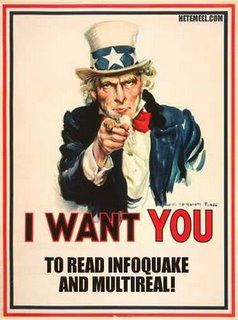 But the best part of the whole thing is that Pat has seen fit, unprompted, to post this neat little Photoshopped poster that puts the full force and weight of Uncle Sam behind getting you to read Infoquake and MultiReal. And really, ain’t that how it should be?
Brief excerpt from the interview:
What do you feel is your strength as a writer/storyteller?
I feel like I’m very good at the worldbuilding aspect of things. Really, structure in general. The trilogy has layers and layers of metaphor in it, and I’m really quite proud of the way it all works together as an organic whole. My tendency is to wander off into history and background and structure, and sometimes I have to curb that impulse. If I had written The Lord of the Rings, it would have been three whole books of the Council of Elrond, and nobody would have read it.Were there any perceived conventions of the science fiction genre which you wanted to twist or break when you set out to write Infoquake and its sequel?Yes, I wanted to avoid the typical mindless action set-pieces that you find in a lot of bad SF, and bad novels in general. I really wanted to write an exciting novel about business. A lot of authors just use the business aspect as window dressing, and then quickly throw their characters into the same car chases and murder mysteries and gunfights. I wanted to write books that really are about the workplace, where the excitement revolves around product demos and marketing meetings and government hearings and that kind of thing. So that’s what I’ve tried to do.
 The wonderful Rob H. Bedford interviews Infoquakeand MultiRealauthor David Louis Edelman for SFFWorld today.
 | |||||||
 |

 There's a new review of David Louis Edelman's Infoquakeup on Grasping for the Wind, which proclaims "What John Grisham has done with the legal thriller, Edelman has done with business." They describe Infoquake as "an adventure filled narrative," and conclude, "Infoquake is well-written and well-cadenced. The climax is fulfilling and exciting, yet it is only a speech, and a marketing one at that. Edelman has so well woven the elements of his plot together that Natch’s simple speech has a much power and excitement to it as another science fiction story’s destruction of a spaceship or a fantasy’s evil overlord dying hideously at the hands of a hero. That takes skill to write, and Edelman has it in spades. I highly recommend this novel."


